
OEM Swiss CNC Lathe: Precision Machining for High-Volume Production
2026-07-27
In today's high-volume manufacturing landscape, precision isn't just a goal—it's the bare minimum. OEM Swiss CNC lathes have become the backbone of industries demanding micron-level accuracy and relentless throughput. But not all machines are created equal. Enter WINNRUI CNC, a name synonymous with robust Swiss turning solutions that merge cutting-edge engineering with real-world production demands. Whether you're churning out complex medical components or intricate watch parts, the right lathe can redefine your efficiency. Let’s explore what makes Swiss-type machining the gold standard for high-volume precision—and why WINNRUI CNC is a partner worth watching.
Why Swiss CNC Lathes Excel in OEM Manufacturing
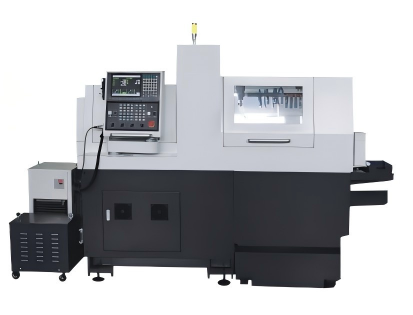
Swiss CNC lathes have carved out a special niche in OEM manufacturing due to their ability to handle long, slender parts with exceptional precision. Unlike conventional lathes, the sliding headstock design feeds the workpiece through a guide bushing, providing continuous support right at the cutting point. This results in minimal deflection and vibration, even when machining complex geometries on parts with high length-to-diameter ratios—something that would typically require multiple setups or secondary operations on other machines.
Speed is another critical factor. The simultaneous operation of dual spindles and multiple tool stations allows overlapping machining processes, dramatically cutting cycle times. OEMs often face tight delivery schedules, and the Swiss machine’s ability to turn, mill, and drill in a single setup eliminates idle time between tool changes. It’s not uncommon to see a Swiss lathe complete a finished part from bar stock in one pass, which is a game-changer for high-volume production runs where every second counts.
Beyond raw performance, Swiss CNC lathes offer a level of flexibility that’s hard to match. Quick-change tooling systems and modular setups allow rapid job changeovers, making them ideal for OEMs managing diverse product lines. The enclosed machining area also enhances safety and helps maintain tight thermal stability, ensuring consistent quality across thousands of parts. When these capabilities are combined, it’s clear why contract manufacturers often rely on Swiss technology to tackle jobs that push the limits of other platforms.
Achieving Tight Tolerances at Scale
Scaling up production without sacrificing precision is one of the toughest challenges in modern manufacturing. The key lies in building robust processes that are inherently stable, rather than relying on post-production inspection to catch errors. By integrating real-time feedback loops directly into the machining and assembly stages, we can detect and correct minute variations before they compound. This means every unit, from the first to the ten-thousandth, meets the same exacting standards, with tolerance windows often measured in microns.
Material selection and thermal management play equally critical roles. Even the finest equipment drifts under temperature swings, so our facilities maintain tight environmental controls while using alloys and composites with predictable expansion characteristics. We've also moved beyond traditional toolpath optimization by adopting adaptive algorithms that compensate for tool wear in real time. The result is a system that self-corrects, delivering repeatable accuracy across long production runs without constant operator intervention.
Collaboration with design teams early in the development cycle prevents tolerance stack-up issues that plague high-volume output. By simulating entire assemblies under load and at speed, we identify potential interference or variation long before tooling is cut. This front-loaded engineering effort, combined with statistical process control that monitors dozens of parameters simultaneously, allows us to push the boundaries of what's achievable at scale—turning what used to be lab-only precision into an affordable, mass-produced reality.
Material Versatility Without Compromise
When a single material can naturally shift between roles—bearing weight one moment and flexing with movement the next—it feels less like engineering and more like a quiet kind of magic. The ability to handle entirely different demands without layering on extra treatments or reinforcements means simpler designs, fewer points of failure, and a finished piece that just works, whether it's exposed to sun, rain, or heavy daily use. It's that rare combination of rugged and refined, where varied function never forces you to give up anything you care about.
Instead of choosing between strength, softness, or resistance, you get all of them woven into the same fabric—literally. That means products can be lighter, sleeker, and more honest in their construction because nothing extra is hiding underneath. The real beauty is how effortlessly it adapts: a jacket that insulates without bulk, a bag that holds its shape yet folds flat, or a piece of furniture that can live indoors and out without a second thought. No fine print, no special care, just a material that quietly does more than you'd expect.
What gets lost in the usual talk about versatility is how it actually feels to use something made from a material like this—there's no obvious trade-off nagging at the back of your mind. It doesn't feel like a compromise was struck in a design meeting; it feels like the natural answer was always there. Whether you're pulling it on, packing it up, or putting it through a day's hard wear, the experience stays consistent, and that consistency becomes its own form of quality you can rely on without ever having to think about it.
Streamlining High-Volume Production Runs
When tackling massive order volumes, workflow synchronization across departments becomes the linchpin. We’ve shifted from traditional batch-and-queue methods to a continuous flow model, where raw materials glide straight into processing without stacking idle inventory. Real-time dashboards keep floor managers alerted to bottlenecks, allowing instant rebalancing of tasks rather than waiting for end-of-shift reports. This operational fluidity doesn’t just cut lead times—it slashes work-in-progress holding costs and minimizes the risk of obsolete stock piling up in corners.
Precision in high-volume environments often gets lost in the noise of speed, so we embedded smart tooling and automated quality gates directly into the line. Instead of downstream inspection, each station self-validates critical tolerances before releasing the part. When deviations pop up, the system triages—minor tweaks get auto-corrected, while significant drifts pause only that cell, not the entire plant. The result is a rhythm where every cycle yields conforming output, trimming waste and slashing end-of-line rework.
Beyond machine cadence, we’ve rethought materials strategy to keep pace with peak throughput. Dynamic buffer levels, guided by live demand signals, mean we’re never choked by shortages or drowning in surplus. Partnering with suppliers for sequenced deliveries turns their trucks into rolling extensions of our inventory, offloading stock directly to the point of use. This synchronized material dance lets us surge output without sprawling warehouse footprints, giving us the elasticity to handle seasonal spikes or sudden customer escalations without breaking a sweat.
Complex Geometries Made Simple
When we look at intricate patterns like a nautilus shell or a pinecone, we see repeating forms that unfold in predictable ways. These aren’t the result of complex blueprints but of simple rules applied step by step. Nature doesn’t need a master plan; it just needs a process that repeats, creating complexity from simplicity. Fractals, for instance, are patterns that repeat at different scales—think of a coastline’s jagged outline, which looks similar whether you zoom in or out.
In design and engineering, the same principle holds true. Instead of trying to construct a complicated shape all at once, we can break it down into basic operations—rotation, scaling, and translation. A spiral staircase isn’t built by carving a giant helix; it’s a series of identical steps, each placed with a slight rotation. By focusing on the relationships between parts rather than the whole, even someone without advanced math can create stunning geometric forms.
Digital tools take this idea further, letting us play with parameters and see immediate results. With a few lines of code or a parametric modeler, you define how elements relate, and the software handles the repetition. What emerges often looks far more intricate than the effort you put in. It’s like sketching a single leaf but ending up with an entire branching tree. The beauty is in the underlying simplicity.
The Future of Precision Automation
Precision automation is poised to break free from the rigid confines of pre-programmed routines. Tomorrow's systems will sense, adapt, and refine their own movements in real time, learning from subtle variations in materials and environments. This adaptive intelligence means a robotic arm can adjust its grip for a fragile glass vial on the fly, or a CNC machine can compensate for tool wear mid-operation without human intervention. The era of strictly deterministic automation is giving way to machines that understand context and react with nuanced finesse.
At the heart of this evolution is the convergence of edge computing, advanced sensor fusion, and tiny yet powerful machine learning models running directly on devices. Decisions that once required a cloud round-trip will happen locally, in microseconds. This unlocks new levels of precision in time-sensitive tasks—think of laser micro-welding where a vision system identifies and corrects alignment errors between pulses, or high-speed pick-and-place operations that dynamically re-plan trajectories to avoid collisions while maintaining sub-micron accuracy.
Looking further ahead, precision automation will blur the line between tool and artisan. We'll see machines that don't just replicate human dexterity but surpass it, working at scales and speeds beyond our biological limits. Collaborative robots will anticipate a human partner's next move and seamlessly hand off delicate components. Modular, self-calibrating production cells will reconfigure themselves overnight to switch from manufacturing medical devices to assembling circuit boards, all while maintaining exacting tolerances. This isn't just efficiency—it's a fundamental shift toward systems that are as supple as they are exact.
FAQ
The Swiss approach really shines with long, slender components that have diameters under 32 mm. Think medical bone screws, electronic connector pins, watch stems, and aerospace fasteners. Because the guide bushing supports the stock so close to the cutting action, you can hold incredibly tight tolerances on parts that would deflect badly on a conventional lathe.
Absolutely. Modern Swiss lathes routinely hold ±0.0002 inches and can mill, drill, tap, and turn in a single setup. The multi-axis configuration lets you machine angled holes, off-center flats, and intricate profiles without moving the part to another machine. It’s common to finish a part that goes straight from the Swiss lathe into assembly with no additional work.
OEM partnerships let you keep full ownership of the intellectual property while leaning on the machine builder’s expertise. Instead of investing in equipment and training, you get a dedicated production cell configured for your exact part. The manufacturer handles programming, tooling, and process refinement under your specs, which speeds up time-to-market without exposing your design to internal bottlenecks.
You’re not limited to brass and mild steel. We regularly run stainless steel alloys like 316 and 17-4 PH, titanium grades 2 and 5, Inconel, aluminum, and a range of engineering plastics. The high-pressure coolant and rigid setup on Swiss lathes make even gummy or work-hardening materials manageable in long production runs.
It usually starts with a feasibility review and a few prototype batches to dial in the process. Once the cycle is validated, we move to a pilot run of maybe 1,000–5,000 pieces to confirm capability. Full-scale production can hit 50,000 parts per month fairly quickly, but the timeline depends on tooling lead times and material availability. OEM partners often keep safety stock of bar, so supply hiccups don’t stall delivery.
The key difference is in how the material is fed. Swiss lathes push the bar through a guide bushing, so cutting happens right at the point of support. This reduces vibration and allows for much longer length-to-diameter ratios. You also get simultaneous backworking, meaning you can machine both ends of a part in one cycle. For high-volume small parts, it’s dramatically more efficient.
They’re typically part of the main program. Swiss machines have live tools on the gang slide or turret that can perform cross drilling, slotting, thread whirling, and knurling without stopping the bar feed. If a part needs a very specialized treatment like spline rolling, that might be done in-line with a separate attachment, but most features are produced directly on the machine.
Conclusion
OEM Swiss CNC lathes have become the backbone of high-volume precision manufacturing, combining speed, accuracy, and flexibility in ways that traditional turning centers cannot match. Their unique sliding headstock design guides bar stock through a guide bushing, providing support mere millimeters from the cutting edge. This near-tool rigidity drastically reduces deflection, enabling consistent part-to-part repeatability even when producing thousands of intricate components. Whether machining medical bone screws, aerospace connectors, or microelectronic pins, these machines hold tolerances as tight as ±2 microns across long production runs. The integration of multiple spindles and live tooling transforms a single setup into a complete machining cell, performing turning, milling, drilling, and thread whipping without operator intervention. This consolidation not only slashes cycle times but also preserves dimensional stability, eliminating the stacking errors common in multi-machine workflows.
Material versatility further amplifies the Swiss lathe's value in OEM environments. From free-machining brass to difficult stainless steels, titanium, and even engineering plastics like PEEK, modern Swiss machines adapt cutting parameters and coolant strategies on the fly to preserve surface integrity and tool life. High-pressure through-tool coolant and programmable chip breakers effectively manage stringy or abrasive swarf, a critical factor when running lights-out operations spanning multiple shifts. As industries push toward greater miniaturization and complexity, Swiss lathe technology continues evolving with features like B-axis contouring, laser cutting, and integrated metrology systems. Real-time process monitoring, adaptive tool compensation, and predictive maintenance algorithms are gradually transforming these machines into self-optimizing production hubs. For OEMs balancing cost pressures with uncompromising quality demands, Swiss CNC lathes represent not just a machining solution but a long-term strategy for staying competitive in a landscape where precision is no longer negotiable.
Contact Us
Contact Person: Tim
Email: [email protected]
Tel/WhatsApp: +86 15522553731
Website: https://www.winnrui-cnc.com/