

Moss Decorative Recommendations for a Lush, Low-Maintenance Home
2026-09-18
Let’s be honest—most of us want a home that feels alive with green, yet very few of us have the time (or memory) to keep delicate plants thriving. Moss changes that equation. It gives you that lush, forest-floor texture without the watering can, the grow lights, or the guilt when you forget for a week. Whether you’re styling a cozy reading nook or a bright entryway, preserved moss offers a surprisingly realistic, zero-maintenance alternative. In this post, I’ll share my favorite moss decorative recommendations for a lush, low-maintenance home—and highlight how PHLEEYA helps you pull it all together with pieces that actually look good in real spaces.
Framed Moss That Beats Houseplant Drama
Most houseplants come with a quiet ultimatum: water me just enough, give me the right light, and don't you dare leave for two weeks. Miss one cue and you're sweeping up yellow leaves or battling fungus gnats. Framed moss sidesteps all of that. It's real moss that's been preserved to hold its soft texture and deep green tone without needing a single drop of water, a grow light, or a prayer.
What you get instead is a piece of living-room art that just sits there looking lush, season after season. No soil to spill, no drainage holes to fuss over, no repotting marathons every spring. If it gathers dust, a quick puff of air or a soft brush is all the maintenance it asks for. It's the houseplant aesthetic minus the houseplant anxiety.
That's why framed moss tends to win over people who travel often, work long hours, or simply admit they have a brown thumb. You hang it, you forget it, and it still greets you with the same calm, woodsy presence the day you brought it home.
Terrariums Thriving on Forgetfulness
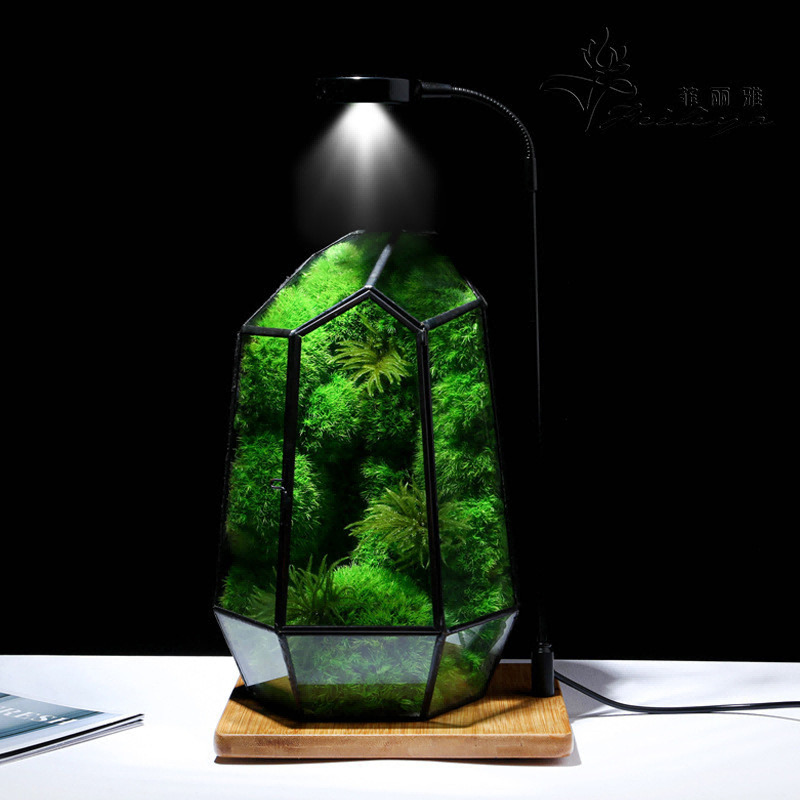
Most houseplants sulk if you glance away for a weekend, but a closed terrarium almost prefers it when you forget it exists. Once the glass lid settles into place, a quiet cycle begins: moisture rises, condenses, and drips back into the soil, mimicking the rainfall of a tiny forest. The plants drink at their own pace, and if you skip watering for a week or three, they rarely hold it against you.
That doesn’t mean you can seal a jar and never look again, but the margin for error is wonderfully wide. Ferns, mosses, and peperomia thrive in the same humid haze that would drown a cactus. Instead of fussing over a watering schedule, you’re mostly just choosing where the light falls and occasionally cracking the lid to let in fresh air. Forgetfulness becomes less of a flaw and more of a design principle.
The real joy arrives when you notice a new frond unfurling weeks after you last remembered to check. The terrarium wasn’t waiting for your care; it was simply getting on with its own small weather. For anyone who has killed a succulent by accident, that kind of resilience feels like permission to enjoy plants without becoming their caretaker.
The Bath Mat That Grows
Imagine stepping out of the shower onto a mat that feels more like a living patch of moss than a slab of synthetic fiber. This is the bath mat that grows—a curious blend of practicality and quiet wonder. Instead of trapping moisture in rubbery loops, it uses a base layer embedded with fast-sprouting seeds. Within days of regular use, tiny green shoots push through the surface, turning your bathroom floor into a miniature meadow. The effect is oddly soothing, as if the room itself has taken a slow, damp breath.
Maintenance isn't about scrubbing or machine washing. You simply keep the mat in a spot with indirect light and let the humidity from your daily routine do the watering. The sprouts are resilient, chosen for their tolerance of low light and occasional barefoot traffic. They don't grow tall or messy; they form a low, springy carpet that dries quickly between showers. It's a small rebellion against the sterile, disposable logic of most bath accessories—a mat that asks to be nurtured rather than replaced.
There's a certain honesty to watching it change week by week. When the growth becomes too dense, you can trim it back with scissors, and the clippings compost easily. Or let it thin naturally and reseed itself. Either way, it resists the idea that a bathroom has to be a dead zone of plastic and bleach. This mat doesn't just catch water; it transforms a mundane routine into a daily encounter with something alive.
Moss in the Stairwell, Finally
For three years I watched that corner of the stairwell on the way to the fourth floor. The concrete stayed bare through every season—gray dust, a crack running from the handrail anchor, the occasional cigarette butt swept into the angle by the wind. Then one Tuesday in early March, after a week of steady rain, a patch of moss appeared just below the window ledge. Not much: a smudge of green no bigger than a palm, but bright enough to stop me mid-step.
I started checking it the way you check a mailbox. Some mornings it seemed unchanged; after a humid night it spread sideways, tiny upright stems catching the light from the stairwell window. The smell changed too—wet stone and something faintly sweet, like overturned soil. The building manager never scrubbed that corner, maybe because nobody used the stairs after the elevator got fixed. So the moss grew in peace, fed by the drip from the window frame and the north-facing shade.
What struck me most was the wait. For years I walked past that spot without expecting anything, and now the stairwell had its own slow event. No one else seemed to notice. A neighbor hurried down with her laundry basket, stepping around the damp patch without a glance. I didn't point it out. Some things just need time and a quiet corner, and then one day they're simply there.
A Green Sigh for Dark Corners
There’s a quiet relief that settles into dim hallways and forgotten stairwells when a green plant takes root there. Not the loud cheer of a sunroom, but a softer exhale—a sigh that seems to loosen the tight corners and let the shadows breathe. A trailing pothos on a high shelf or a sturdy snake plant tucked beside a north-facing window doesn’t just fill space; it rewrites the mood of a room people usually pass through quickly. The dark corner stops being an afterthought and becomes a place your eye lingers, drawn by the slow, steady life hanging in the air.
What works best in these low-light pockets is often the opposite of what you’d expect from a houseplant. No showy blooms, no fragile fronds. Instead, you want resilience with a quiet kind of architecture—broad leaves that catch the faintest glow, stems that climb without complaint, roots that forgive a missed watering. A ZZ plant or a cast iron plant can sit in near-shadow for months and still push up a new shoot, as if to say the corner wasn’t dark at all, just waiting for the right kind of green to notice it.
The trick is to lean into the dimness rather than fight it. Choose a glossy-leafed plant that reflects whatever light slips in from a nearby doorway or lamp. Place it slightly off-center, not pushed flat against the wall, so the shape has room to cast its own small shadow. Water less than you think, and let the top inch of soil dry out completely between drinks—these plants would rather be thirsty than sit in damp, airless soil. Over time, the corner gains a presence it never had before, and you might catch yourself pausing there just to hear that green sigh.
Your Home's Quiet Green Layer
A quiet green layer isn't about filling every corner with plants. It's the soft backdrop of leaves near a window, the low row of ferns on a shelf, or a single trailing pothos draped over a kitchen cabinet. You notice it the way you notice a change in air pressure—subtly, and only after you've relaxed into the room.
To build that layer, think about height and texture rather than just count. Pair tall, upright stems with sprawling ground covers, and mix glossy leaves with matte, fuzzy ones. A cluster of three pots in varying sizes can do more than a dozen scattered around, because the eye sees one continuous, breathing band of green instead of isolated objects.
Care stays in the background too. Water when the top inch of soil feels dry, wipe leaves once a month, and rotate pots so growth doesn't lean hard toward the light. The reward is a room that feels steadier—like someone left a window open in the best way.
FAQ
Yes, but it's risky. Outdoor moss often carries pests or mold, so quarantine it for a few weeks and mist lightly before bringing it inside. Better yet, buy preserved or live moss from a nursery to avoid surprises.
Light is the main culprit. Keep it away from direct sun and stick to distilled water for misting. If it's preserved moss, don't water at all—just dust it gently with a soft brush.
Try a moss frame or a shallow tray filled with stones and driftwood. You can also glue sheet moss onto a cork board to create a living art piece that hangs on the wall.
Not always. Many mosses grow on bark or rock if the humidity is high enough. A base of sphagnum or coir helps, but the real key is moisture, not soil depth.
Preserved moss is your best bet since it's no longer alive and needs zero light. For live moss, a small LED grow light on a timer works fine without any natural light.
It depends on the lid. Open terrariums usually need misting every two to three days, while closed ones might only need it once a month. Check for condensation—if the glass is foggy, skip the misting.
Yes, pair it with ferns or small bromeliads. Just make sure they have similar humidity needs and leave enough space so the moss isn't smothered by faster growers.
Overwatering. Moss loves humidity but hates sitting in water, so use a spray bottle instead of a watering can and let it dry slightly between mistings.
Conclusion
A framed panel of cushiony moss where a fussy fern used to sulk doesn't need a watering schedule or leaf cleanup—it just stays plush and deep green for years. That's the easy appeal of preserved moss, and it's nudging houseplant anxiety out of more rooms. Put a glass terrarium filled with mood moss and a few stones on a shelf, and you get a tiny forest that actually likes your forgetfulness; the closed lid keeps humidity in, so a light mist every few weeks is plenty. For a stranger turn, some people are now stepping onto a living moss bath mat after the shower. It drinks the drips, feels springy, and never goes in the washing machine. Even the stairwell, usually a dim dead zone for plants, can carry slim moss panels along the risers or a narrow strip where nothing else would survive.
Dark corners where even pothos gives up finally get a green sigh with clumping reindeer moss tucked into shallow trays or fixed to driftwood. Because preserved moss asks only for stable humidity, it slips into your home's quiet green layer—above kitchen cabinets, along a bookshelf, or around a window that never sees direct sun. The result is a lush look that doesn't punish you for a busy week. You're not keeping moss alive; you're arranging its already-finished softness. Swap the watering can for an occasional dusting, and the whole place still feels like a shaded woodland floor.
Contact Us
Contact Person: Mr. Luo
Email: [email protected]
Tel/WhatsApp: 86 18100895505
Website: https://www.feiliyaflowers.com/en/