

Cleanroom HVAC System Contractor Guide for Choosing the Right Partner
2026-08-28
Selecting a cleanroom HVAC system contractor is a decision that directly impacts contamination control, energy efficiency, and regulatory compliance. Yet many facility managers overlook the human factor—how well a contractor communicates, documents changes, and responds when things go wrong. This guide cuts through the noise, using practical lessons from GENO Pharmatech to show you exactly what separates a reliable partner from a costly liability.
Pressure Cascades Are the First Thing a True Cleanroom Contractor Will Ask About
When you sit down with a contractor who actually builds cleanrooms for a living, the conversation rarely starts with fan specs or filter counts. It starts with pressure cascades. That's because the air pressure relationship between adjacent rooms dictates how particles move when doors open, how gowning protocols function, and whether your cleanroom will ever pass certification. A contractor who skips this topic is either guessing or hoping you won't notice.
Designing a proper cascade means mapping every transition: from the dirtiest corridor to the gowning anteroom, from the anteroom to the main cleanroom, and from the cleanroom to any critical process zones. Each boundary needs a defined differential pressure — typically 10 to 15 Pascals between ISO classes, but that number shifts based on ceiling height, door undercuts, and exhaust rates. Without this granular map, you end up with air flowing the wrong way and a cleanroom that fights itself.
A genuine cleanroom contractor will also ask about your operational reality: Do carts roll through frequently? Are pass-through chambers needed to reduce door swings? What happens during filter changes or power dips? These questions aren't theoretical — they determine whether the cascade holds up under daily use or collapses the moment someone props a door open. If your contractor leads with lighting layouts instead, you might be talking to a general builder wearing a cleanroom hat.
Separating Cleanroom Experience from Generic HVAC Credentials
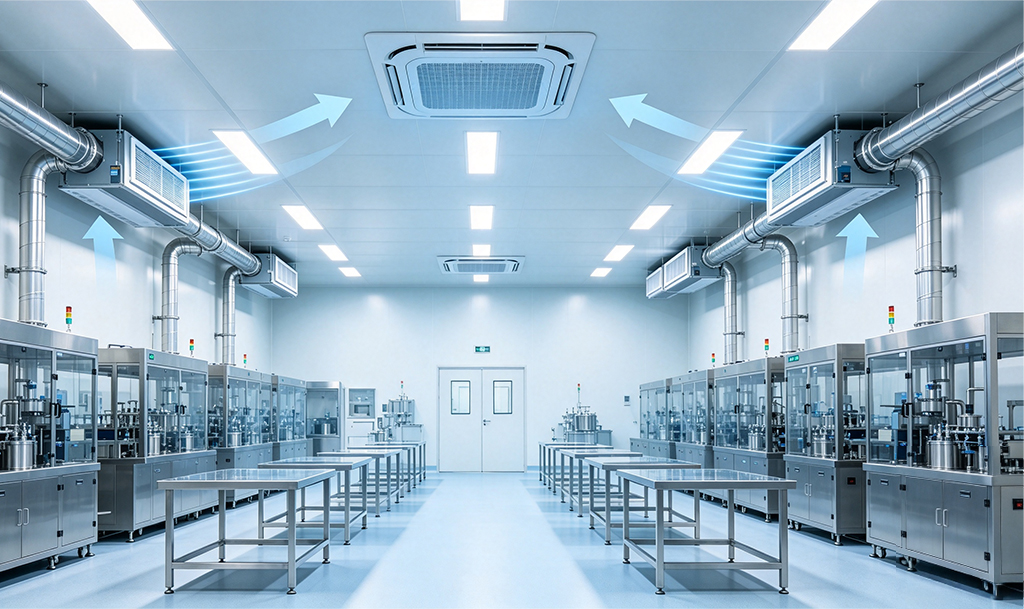
Most HVAC certifications prove a technician can handle comfort cooling, duct sizing, and basic refrigeration cycles. Cleanrooms operate under a different set of rules entirely. The pressures, filtration cascades, and particle budgets that matter in a pharmaceutical suite or semiconductor fab rarely appear in standard licensing exams, so a generic credential tells you almost nothing about whether someone can keep a cleanroom within spec.
Ask any facility manager who has hired both types of technicians, and the pattern is consistent. A strong commercial HVAC background helps with the mechanical side, but it does not prepare a person for gowning protocols, HEPA/ULPA integrity testing, or the consequences of a single breached pressure differential. Cleanroom work demands familiarity with ISO 14644 classifications, airflow visualization, and recovery times after door openings—none of which are covered in a typical HVAC apprenticeship.
That is why cleanroom-specific experience deserves its own weight in hiring and project planning. A technician may hold every refrigerant handling card available and still cause a batch failure by swapping a filter incorrectly or ignoring a 0.5 Pa drift. Treating cleanroom competence as an extension of ordinary HVAC skills flattens the real gap between the two disciplines.
The HEPA Integrity Test Conversation That Exposes Shortcut Contractors
Ask any contractor how they verify a HEPA filter after installation, and you'll learn more in thirty seconds than a week of reviewing quotes. The ones who mumble something about "airflow checks" or "visual inspection" are telling on themselves. A true integrity test doesn't involve guesswork—it requires a photometer, an aerosol challenge, and a technician who can read the scan data without hesitation.
The conversation that exposes shortcut contractors usually starts with a simple question: "What do you do if the filter fails?" Listen carefully. A straight answer involves isolating the leak, repairing or replacing the filter, and retesting until the penetration falls below the allowed limit. If they start talking about "adjusting the fan" or "cleaning the gasket and calling it good," you've found someone who cuts corners when nobody's watching.
Another red flag appears when you ask for the test report. Legitimate contractors hand over a document showing upstream and downstream particle counts, challenge concentration, and scan speeds—not a one-line email saying "passed." If the report is vague, missing, or arrives before the work is even finished, that's not efficiency. That's a contractor hoping you won't know the difference between a real integrity test and a theatrical performance.
Air Change Rates Are Not One-Size-Fits-All: Tailoring to Your Process
Many facilities still rely on a fixed air change rate—often 6 or 10 per hour—without asking what the space actually needs. That habit comes from older guidelines that treated ventilation as a blunt instrument. Yet a pharmaceutical cleanroom handling potent compounds has little in common with a welding bay or a battery charging room. Air change rates cannot be copied from one process to another; they must respond to the specific contaminants, heat loads, and occupancy patterns in each environment.
Consider two processes side by side. A solvent degreasing operation releases heavy vapours that sink toward the floor, demanding low-level extraction and careful air distribution, not just a high turnover number. A machining area producing oil mist needs capture at the source before the aerosol spreads. The same air change rate applied to both will either waste energy by over-ventilating one space or leave workers exposed in the other. Factors like contaminant density, toxicity, generation rate, and even the room's geometry change the equation entirely.
The better approach is to derive the air change rate from a thorough assessment—air sampling, occupational exposure limits, and sometimes computational fluid dynamics modelling. That kind of tailoring often reveals that a lower rate, paired with effective local exhaust, outperforms a higher general ventilation rate. The payoff shows up in lower fan energy, longer filter life, and a workspace that actually meets exposure standards. A one-size-fits-all number is easier to quote, but it rarely fits the process it is meant to protect.
Maintenance Schedules That Don't Undermine Your Validation Status
A maintenance schedule that trips your validation status usually comes down to timing, not intent. When a preventive maintenance event slips past its due date, the system sees that deviation and flags the equipment as noncompliant. The fix isn't to pad every interval with extra slack; it's to build schedules around actual usage patterns and risk levels. Critical assets may need tighter windows, while low-impact tools can tolerate longer cycles without anyone losing sleep.
Another overlooked issue is how you document postponements. A simple "delayed one week" note without a formal deferral process can undermine the entire validation argument. Create a clear, pre-approved pathway for rescheduling: define who can authorize a delay, what justification is required, and how the new date gets locked in. That way the schedule flexes without breaking the chain of evidence.
Finally, treat maintenance completion as a data point in your validation review, not just a checkbox. If you repeatedly miss targets on a particular piece of equipment, that's a signal that the interval or the procedure needs adjustment. Adjusting the schedule based on real performance data keeps the system honest and your validation status intact.
Why the Cheapest Bid Often Hides the Highest Recertification Risk
A low initial price can look like a smart win, but it frequently signals corners being cut in materials, testing, or documentation. Suppliers who underbid often rely on unproven components or skimp on the very processes that keep a product compliant over time. When recertification comes around, those shortcuts surface as failed audits, missing traceability, or components that no longer meet the original standard.
Recertification is not a rubber stamp. It involves re-testing under the same or updated criteria, and any drift from the original approved design raises red flags. Cheaper bids may have been based on one-time compliance, not sustained performance. That means a product can pass its first certification but fail the next because the manufacturer changed a supplier, altered a formula, or let quality controls slide to protect their thin margin.
The real cost shows up later in downtime, rework, and rushed replacements. A facility that chases the lowest price often ends up paying for repeated recertification attempts, emergency engineering support, and even lost operating permits. The bid that looks cheapest on paper can become the most expensive once the recertification cycle starts.
FAQ
Look for completed projects in industries similar to yours, such as pharmaceuticals, semiconductors, or biotechnology. Request specific references and ask how the contractor handled ISO 14644 or GMP requirements, from initial design through final validation. A solid track record should include documented temperature, humidity, and pressure control performance, not just installation photos.
Cleanroom HVAC is built around contamination control, not just comfort. You're managing particulate counts, precise temperature and humidity bands, and pressure differentials between adjacent spaces. Systems typically rely on HEPA or ULPA filtration, controlled air change rates, and carefully planned airflow patterns like laminar or turbulent flow. Standard commercial HVAC rarely addresses any of that.
They should be comfortable working with ISO 14644 series, EU GMP Annex 1, ASHRAE 170 for healthcare applications, and relevant local building codes. Familiarity with NEBB or CETA testing procedures is also a strong sign, because it means they understand how to verify filter integrity, airflow uniformity, and room recovery rates.
Commissioning proves the installed system performs as designed under real operating conditions. Validation documents that the cleanroom actually meets its target classification. A contractor who can handle both saves you from hiring separate commissioning agents later and gives you a clearer handover package, including test reports, balancing data, and pressure mapping results.
Ask them to walk through a typical cleanroom layout and explain where supply and return grilles belong, how they would maintain positive or negative pressure, and how they prevent cross-contamination between rooms. A strong answer should include specific air change rates for your target ISO class and mention the role of door interlocks or airlocks if applicable.
Request sample deliverables such as design drawings, equipment submittals, test reports, and as-built documentation. Also ask how they handle field modifications: do they use a formal RFI process, update drawings in real time, and communicate deviations to the project team? The quality of documentation often reflects the quality of the installation.
Very important. A contractor who has built ISO 7 cleanrooms for electronics may not understand the aseptic processing requirements of a pharmaceutical ISO 5 area. Ask for case studies that match your industry, cleanliness level, and any regulatory oversight. The right partner should already know your common pain points before the first site visit.
Vague answers about filtration options, no references in regulated industries, or a reluctance to provide commissioning documentation are serious warning signs. Also be cautious of bids that seem unusually low by skipping airflow visualization, pressure mapping, or filter integrity testing. If they treat cleanroom HVAC like standard office air conditioning, they are not the right fit.
Conclusion
A contractor who doesn't ask about pressure cascades before anything else probably hasn't spent much time inside an actual cleanroom. The way air moves from positive to negative zones determines whether contaminants are pushed away from critical processes or pulled straight into them, and a real cleanroom HVAC specialist knows this is the foundation every other decision rests on. That same depth of experience shows up when you dig into their project history—generic HVAC credentials don't mean someone understands HEPA filter banks, low-return placements, or the subtle issues that only appear after months of operation. One of the fastest ways to separate the genuine experts from the shortcut takers is to ask how they handle HEPA integrity testing. If their answer is vague about scan testing, challenges, or repair documentation, they're probably planning to skip the steps that keep your certification valid.
Air change rates are another place where off-the-shelf thinking fails. The right number depends on the process, particle generation, and whether you're working with ISO 5 or ISO 8 conditions—so a contractor who gives you a single rate without asking what happens inside the room is guessing. Maintenance schedules matter just as much as the initial build. If the plan calls for shutting down critical systems without thinking about airflow recovery or validation impact, you'll face recertification headaches later. And when bids come in far apart, the cheapest one often isn't a bargain; it usually means corners will be cut on filtration, instrumentation, or testing. That hidden cost shows up at your next certification audit, when a failed pressure differential or particle count forces you to stop production and redo the work that should have been done right from the start.
Contact Us
Contact Person: Amy Yang
Email: [email protected]
Tel/WhatsApp: 008619330882686
Website: https://www.genopharmatech.com/