Chinese Shuttle System Pallet Factories Driving Warehouse Automation Forward
2026-07-07
The quiet revolution in warehouse logistics is gaining momentum, and at its heart lies a simple yet transformative concept: the shuttle system pallet. Across manufacturing hubs, factories are retooling their operations with automated storage and retrieval marvels, and a rising star in this space is Lanyuda. Their advanced pallet shuttle solutions are redefining speed, density, and flexibility—turning traditional warehouses into hyper-efficient fulfillment centers. But what makes this tech tick, and why are industry leaders betting big on it? Let’s dive into the engine rooms driving warehouse automation forward.
Redefining Warehouse Efficiency with Shuttle Pallet Systems
Traditional static racking often leaves aisles empty and vertical space underused, forcing operations to choose between density and speed. Shuttle pallet systems flip that compromise entirely, letting autonomous carts zip deep into lanes to store or retrieve loads while operators stay focused on putting away and picking elsewhere. The result is a warehouse where every cubic foot works harder, without the delays that usually come with high-density storage setups.
What really changes the game is how these shuttles adapt to real-world surges. Instead of relying on fixed first-in-first-out flows, they can reshuffle pallets on the fly, prioritizing fast-movers or consolidating partial lanes during off-peak hours. Managers gain a live map of inventory that stays accurate without cycle counts, and sudden spikes in order volume don’t bottleneck at the rack face—the system simply redirects carts where they’re needed most.
Beyond the throughput numbers, the technology quietly solves nagging operational headaches. Less forklift traffic inside narrow lanes means fewer scuffs and safety incidents, while the gentle handling preserves pallet integrity better than clamp trucks ever could. Temperature-controlled environments benefit too, since shuttles can function in deep freeze conditions without the energy waste of opening wide aisles. It’s a practical upgrade that pays off in silence, day after day.
The Rise of Chinese Manufacturing in Automated Storage
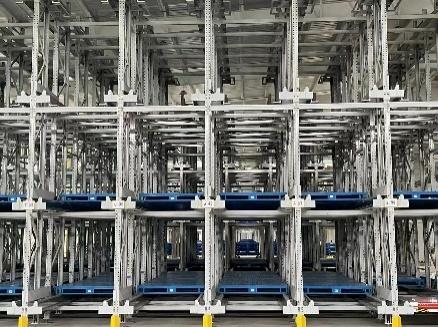
Over the past decade, Chinese manufacturers have shifted from labor-intensive warehousing to highly automated storage and retrieval systems. This transformation is driven by rising labor costs, the need for greater accuracy, and the sheer scale of e-commerce demand. Companies that once relied on manual picking are now deploying autonomous mobile robots, shuttle systems, and AI-driven warehouse management software, fundamentally reshaping internal logistics.
A key factor behind this surge is the deep integration of domestic robotics and industrial software. Local players like Geek+ and Hikrobot have developed flexible, cost-competitive solutions tailored to the high-mix, high-volume nature of Chinese supply chains. These systems are not just replacing manual labor but enabling new levels of density and throughput—often doubling storage capacity within the same footprint. Meanwhile, government initiatives encouraging smart manufacturing have accelerated adoption across sectors from automotive parts to consumer goods.
Outside China, this expertise is increasingly visible. Chinese automated storage tech is being exported to emerging markets and competing with established European integrators on performance and price. While challenges remain in standardizing components and software interfaces, the sheer velocity of deployment and refinement in China’s domestic market has created a generation of systems that are both rugged and intelligent—raising the global bar for what automated storage can achieve.
Custom Solutions for Diverse Industry Needs
Every industry operates under its own set of rules, challenges, and customer expectations. That’s why off-the-shelf approaches rarely deliver the impact businesses are looking for. By diving deep into the nuances of each sector—whether it’s healthcare, manufacturing, logistics, or retail—we shape strategies and tools that align precisely with operational realities. It’s not about forcing a generic framework; it’s about understanding the workflow, the compliance landscape, and the pain points that keep decision-makers up at night, then designing from that ground truth.
Over the years, we’ve seen how a tailored approach can pivot an entire organization. A medical device company, for example, needed traceability built into every component, while a food distributor required real-time temperature monitoring across a fragmented supply chain. One wanted strict access controls; the other, seamless mobile integration. Their definitions of success were worlds apart. That granular focus means we never stop at surface-level consulting—we build, test, and refine until the solution feels native to the industry it serves.
This philosophy extends beyond initial deployment. Markets shift, regulations evolve, and customer behaviors change without warning. A customized solution is only as good as its ability to adapt. That’s why we embed flexibility into the core architecture, allowing for swift pivots without a complete overhaul. From dynamic compliance reporting to modular feature expansions, the goal is to give businesses a foundation that grows with them—keeping them resilient in the face of disruption.
Cutting-Edge Technology Behind the Scenes
Most users never see the neural networks that quietly reshape their raw footage into polished clips, running frame by frame at speeds that would have sounded absurd just a few years ago. The real magic isn't a single breakthrough but a patchwork of custom-trained models—one that stabilizes shaky handheld video, another that predicts motion blur to sharpen fast-moving subjects, and a third that remaps color based on the content's mood rather than a fixed LUT. These models don't just process; they make aesthetic judgments in milliseconds, trained on millions of scenes labeled by cinematographers rather than engineers.
Underneath the familiar editing interface, a distributed compute layer dynamically spins up GPU clusters only when a heavy render is queued, then tears them down seconds after completion to keep costs from spiraling. This orchestration system decides in real time whether to process a task locally on the user's device, route it to a nearby edge node, or send it to a central cloud pod—balancing latency, privacy, and sheer horsepower. Meanwhile, a streaming synchronization protocol lets multiple collaborators edit the same timeline without file locks or version conflicts, resolving changes through a behind-the-curtain algorithm that understands the difference between moving a clip and retiming it by a few frames.
Perhaps the most invisible innovation is the asset intelligence layer that compresses, caches, and pre-fetches media in volatile network conditions. Instead of requiring editors to manage proxies or rendering previews, the system builds a speculative map of what footage will be needed next based on editing patterns, down to the exact timecode. It's a constant push-pull between predictive loading and on-the-fly transcoding, all hidden so seamlessly that it feels like local storage even when pulling 8K raw files from a server halfway across the globe.
Cost-Effective Automation Without Compromise
Achieving meaningful automation doesn't have to drain your budget. By focusing on modular solutions and open-source tools, businesses can slash upfront costs while maintaining full control over their workflows. The key is to prioritize integration over replacement—augmenting existing systems rather than forcing a complete overhaul.
Many assume that affordable automation means cutting corners, but that's outdated thinking. Today's flexible platforms let you start small, scale seamlessly, and only pay for what you actually use. This approach ensures that every dollar spent directly contributes to efficiency gains, without locking you into bloated licensing agreements.
Ultimately, cost-effective automation is about smart architecture, not cheap tools. By designing processes that eliminate duplication and manual handoffs, you create a foundation where reliability and speed don't depend on endless spending. The result is a lean operation that outperforms expensive systems built on legacy assumptions.
Scaling Operations with Modular System Designs
Growing a business often brings complexity that can slow things down. Instead of adding more layers to a rigid structure, modular system design lets you break operations into building blocks that can be rearranged or expanded independently. This approach transforms scaling from a frantic scramble into a manageable, almost lego-like process where each module—be it order processing, customer support, or inventory—functions on its own yet works seamlessly with the rest.
What makes modular systems truly shine is how they absorb growth without cracking. When demand spikes, you don't have to overhaul everything at once; you simply reinforce or replicate the modules that are under pressure. This selective scaling saves time and reduces the risk of destabilizing the whole operation. It also encourages experimentation, because you can tweak one part of the system without fear of unintended consequences elsewhere.
Of course, smooth scaling isn't just about the technical setup—it's also about the team. With clear module boundaries, teams can own their pieces without stepping on each other's toes. A well-designed modular system bakes in resilience and clarity, making it far easier to respond to shifts in the market or internal priorities. When your operations are built this way, scaling up becomes a natural rhythm rather than a disruption.
FAQ
Pallet shuttle systems are semi-automated storage solutions that use a motorized shuttle to move pallets within racking lanes. Instead of a forklift entering each lane, the shuttle does the heavy lifting inside, drastically slashing loading and unloading times while maximizing storage density.
Chinese factories have rapidly scaled up their expertise in automation technology, combining competitive pricing with reliable performance. They’ve invested heavily in R&D and now deliver robust systems that rival legacy European brands, often with faster lead times and stronger customization options.
Modern systems are designed with adjustable sensors and variable speed controls, so they automatically detect pallet dimensions and weight. The shuttle adjusts its lift and movement parameters on the fly, safely handling everything from lightweight retail goods to heavy industrial loads.
Absolutely. Most Chinese shuttle suppliers now offer open API connectivity, allowing their controllers to talk directly to WMS and ERP platforms. This means real-time inventory tracking, automatic task assignments, and seamless coordination with conveyors or robotic picking systems.
Shuttles are built with modular components, so routine upkeep mainly involves battery checks and cleaning of guide rails. Many Chinese manufacturers keep local parts depots in major markets, shipping critical components within days rather than weeks, which keeps downtime minimal.
They scale surprisingly well. Compact shuttle setups can be installed in low-ceiling or narrow facilities, delivering high-density storage without major structural changes. This makes them a viable option for SMEs looking to break into automation without a massive capital outlay.
We’re seeing lithium-ion batteries with ultra-fast charging, AI-driven route optimization that learns traffic patterns, and even 5G-connected shuttles for instant fleet communication. Some manufacturers are also experimenting with lightweight carbon composites to boost speed and energy efficiency.
Conclusion
Chinese shuttle system pallet factories are redefining warehouse efficiency by delivering advanced automated storage and retrieval solutions that seamlessly integrate into modern logistics. These systems, built on a foundation of modular design, allow businesses to scale operations with ease, adapting to fluctuating inventory volumes without compromising speed or accuracy. By leveraging cutting-edge technology such as high-speed lifts, intelligent routing software, and dense storage configurations, these factories enable warehouses to maximize cubic space utilization and dramatically reduce order cycle times. The rise of Chinese manufacturing in this sector has been fueled by a commitment to innovation and a deep understanding of global supply chain demands, resulting in robust systems that rival traditional European counterparts in both performance and reliability.
Beyond technological prowess, Chinese pallet shuttle factories distinguish themselves through tailor-made solutions that address diverse industry needs—from cold storage and food logistics to automotive and e-commerce. Their ability to offer cost-effective automation without sacrificing quality has made automated storage more accessible than ever, empowering businesses of all sizes to transition from manual operations to intelligent, data-driven environments. This customer-centric approach, combined with ongoing investments in research and development, ensures that each system is not just a product but a strategic asset. As warehouse floors evolve into dynamic, automated hubs, China’s shuttle system factories continue to drive the industry forward, setting new benchmarks for efficiency, flexibility, and value in the global market.
Contact Us
Contact Person: Johnny
Email: [email protected]
Tel/WhatsApp: +86 18151010686
Website: https://lydstorage.com