

China PTFE Skived Sheet Properties and Industrial Applications Worth Knowing
2026-11-16
PTFE skived sheet rarely gets attention until a seal leaks, a surface sticks, or a liner fails under aggressive chemicals. That is when sheet quality, thickness control, and raw material selection start to matter. China has become a major production base for these precision sheets, and TAIFNO is a supplier worth knowing for consistent properties and broad industrial use. In this post, we look at the key properties behind skived PTFE sheet performance, the applications where it earns its place, and what to check before specifying it.
How Chinese Skived Lines Hold Tighter Gauges Than Molded Sheet
The advantage begins with the forming route. Molded sheet relies on compacting powder or granules in a cavity, then sintering the panel under heat and pressure. Thickness is set by the tool gap, but fill uniformity, air entrapment, and uneven shrinkage during cooling all push the final gauge around. A skived line takes a different path: a fully sintered billet is rotated against a blade that peels away a continuous layer at a controlled depth. Because the material is already consolidated, the cut thickness is not fighting bulk densification, so the gauge can be adjusted and held with far less variation from edge to edge.
Chinese skiving lines have tightened that control further by combining stable billet preparation with live measurement. The best operations pre-turn the billet surface to remove runout, keep blade temperature from drifting, and feed readings from laser or capacitance gauges back into the tool offset. The correction happens while the roll is turning, often within a few microns, rather than after a batch has already been cut. That closes the loop in a way molded sheet production cannot easily copy because the press cycle sets the whole panel at once and leaves little room for mid-run correction.
The result is not that molded sheet is obsolete. For thick, flat pieces or applications where a little gauge variation is harmless, pressing still works well. But when the tolerance band shrinks below what a compression cycle can reliably deliver, skived material wins by giving the operator a continuous process instead of a one-shot molding step.
Virgin Versus Reprocessed PTFE and What Changes on the Floor
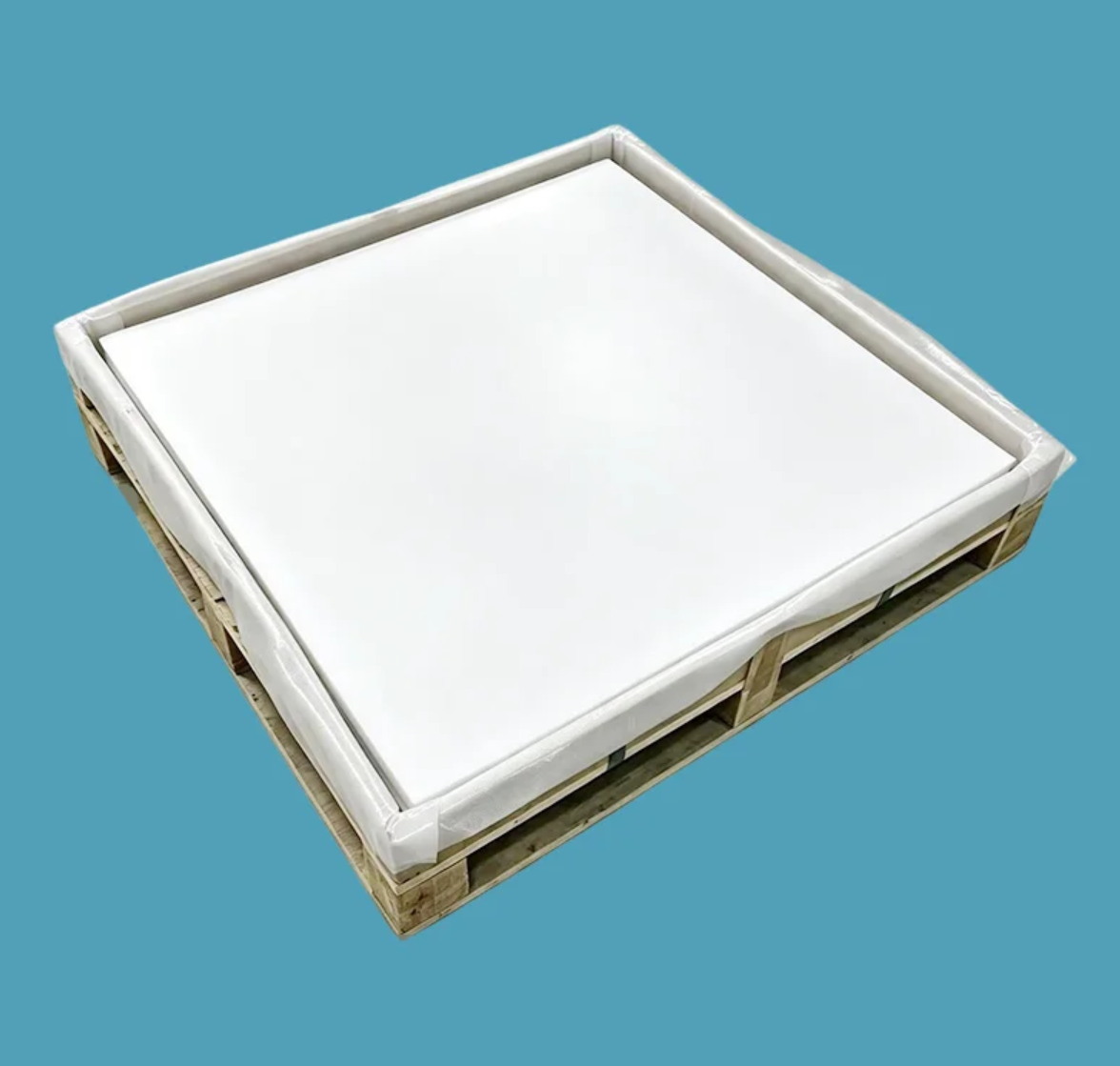
On a production floor, the distinction between virgin and reprocessed PTFE shows up faster than most datasheets suggest. Virgin PTFE carries a consistent molecular weight and a predictable cold-flow behavior, so skiving, molding, and cutting equipment can be dialed in once and left alone for longer stretches. Reprocessed PTFE, by contrast, brings a mix of thermal histories. Some lots flow a little easier under the same pressure, while others resist at the edges, and operators usually notice that in the form of wider thickness variation or a duller surface straight off the tool.
That variability has a direct effect on scrap rates. A shop running virgin material often holds a tighter tolerance without extra sorting, because the resin responds the same way on Tuesday as it did on Monday. With reprocessed PTFE, the floor team may need to adjust dwell time or trim more aggressively after sintering, not because the material is unusable, but because its history is less uniform. In many cases the savings from lower material cost get partially offset by the additional handling and inspection required to keep finished parts within specification.
There is also a practical shift in how the material feels during secondary operations. Virgin PTFE tends to leave cleaner edges and a more consistent white or off-white appearance, which matters when visual acceptance is part of the job. Reprocessed material can show faint color variation or slightly softer corners, and that may be perfectly acceptable for low-load gaskets or wear pads. The real change on the floor is not always mechanical performance; it is the amount of attention needed to keep the process stable with a less predictable input.
Friction, Hardness, and the Maintenance Intervals They Dictate
Friction rarely announces itself until something starts wearing unevenly or a routine inspection turns up unexpected scoring. The feel of a rail surface under a gloved hand can hint at what hardness specs alone never capture: how two materials actually behave when they slide, press, and heat up together. Hardness numbers give you a starting point, but the intervals between service calls are written by the quiet work of contact stress, surface roughness, and the slow accumulation of debris in a loaded interface.
A harder guide rail does not automatically mean a longer maintenance window. In many builds, pairing a very hard rail with a softer sliding element simply shifts the wear to the less expensive part, which can be fine until dimensional drift starts affecting alignment. The interval that matters is the one where measurable change first appears, not the one where outright failure happens. That is where friction data earns its keep: tracking drag force over repeated cycles shows a curve with a long flat middle and a sudden upward turn. Replacing components before that turn saves more than just the cost of the rail itself.
Maintenance schedules built only from manufacturer hardness ratings tend to ignore how lubrication breaks down, how micro-vibrations pack contaminants into crevices, or how a slight misalignment increases local pressure far beyond the nominal load. A practical interval accounts for the full cycle: clean, inspect, measure, re-lubricate, and only then decide if the part stays or goes. Teams that rely on this loop usually find their replacement forecasts improving within a few months, because the wear pattern itself starts telling them what the next interval should be.
Sealing, Insulating, and Lining Roles That Go Past Basic Chemical Resistance
Many engineers treat chemical resistance as a single material property, but real-world sealing and lining failures often trace back to how the polymer behaves under compressive set, temperature swings, and surface wear long before aggressive media ever penetrates the bulk. A gasket that survives a static immersion test can still harden, creep, or lose recovery after months of thermal cycling against a flange face. Likewise, a tank lining that resists sulfuric acid at room temperature may crack when the same vessel cycles between hot washdowns and chilled product, simply because the lining cannot follow the substrate's expansion without delaminating.
The more practical approach is to look at the combined duty: the mechanical squeeze, the flexural strain from vessel movement, the rate of temperature change, and the presence of abrasive particles or cleaning agents. Elastomers with good compression set resistance, such as certain fluoropolymers and high-performance EPDM grades, hold sealing force longer than those chosen only for low swell in a particular solvent. For linings, stress-crack resistance and elongation at break matter as much as a low permeation rate, because a tiny tear will expose the substrate far faster than gradual chemical diffusion ever could.
Specifying a seal or lining then becomes a balance between chemical compatibility and mechanical survivability under real operating cycles. Testing should include not just standard immersion coupons, but also compressed gasket aging, thermal shock sequences, and adhesion pull-off after repeated flex. When these factors are weighed together, the chosen material rarely matches the one listed in a simple resistance chart—and that difference is what separates a short-lived repair from a long-term asset.
Cryogenic to High-Heat Service Without the Usual Panel Cracking
Thermal cycling tends to punish panels long before the rated temperature is ever reached. The trouble usually starts at the bond line, where a rigid adhesive holds materials with different expansion rates in place. In cryogenic conditions that interface contracts hard, and during high-heat swings it moves again in the opposite direction. Once the stress has nowhere to go, the outer skin cracks near fasteners and corners. This panel avoids that failure mode by giving the core and facing enough room to move together instead of fighting the joint.
Rather than a single brittle adhesive layer, the panel uses a compliant transition zone between the skin and the insulation core. That zone absorbs the sharp differential movement that occurs when one side is still cold while the other is heating up. It also spreads mechanical load over a wider area, so a rapid cooldown or a long soak at elevated temperature does not concentrate strain along a narrow line. The result is a surface that stays smooth through cycles that would normally leave a pattern of shallow cracks.
In service, that translates into fewer replacements and less heat loss through damaged facings. Panels that see repeated swings from cryogenic storage to high-temperature process duty hold their insulation value longer, with no visible cracking around the edges or mechanical fixings. It is not a magic material; the operating envelope still matters. But within that envelope, the usual panel fatigue simply does not show up the way it does with conventional construction.
Batch-to-Batch Clues That Reveal a Supplier’s Real Consistency
Most suppliers can send a spotless first sample. The real test happens when you line up three or four production batches side by side and look for the small shifts: the shade of a label drifting warmer, a carton that suddenly feels thinner, a lot code that skips from laser-etched to inkjet without explanation. These aren't defects, but they are signals. A supplier with real consistency carries the same fingerprints from one run to the next, even when things aren't perfect.
Pay attention to the details that nobody bothers to hide because they don't think buyers check. The height of a sealed edge, the torque needed to open a cap, the way a powder settles in its pouch, or the placement of a batch number on a box. When these details stay steady across months and reorders, you're seeing discipline rather than luck. Sudden changes usually mean a new subcontractor, a material substitution, or a production shortcut that hasn't been disclosed.
It's also worth comparing batch records, not just finished goods. Ask for the actual process data: mixing times, curing temperature ranges, machine speeds, operator sign-offs. Gaps or convenient missing pages matter more than the numbers themselves. A consistent supplier can show you the boring, repetitive proof behind each shipment. If every batch looks like a one-off project, you're probably dealing with a trading company rather than a manufacturer.
FAQ
Skived sheet is peeled in a continuous layer from a sintered PTFE billet, which gives it a more uniform thickness, smoother surface, and better control over thin gauges. That makes it easier to handle in precision gasket cutting, lining, and electrical insulation work.
Its resistance to nearly all chemicals, combined with low moisture absorption and low permeability, helps protect flanged joints and vessel surfaces from aggressive acids, solvents, and caustics. The material also remains dimensionally stable enough to keep a reliable seal under moderate bolt loads.
PTFE skived sheet can typically work continuously from about -180 degrees Celsius to 260 degrees Celsius. High-temperature exposure is possible, but compressive strength and load-bearing capacity drop as temperature rises, so reinforcement or support is often needed above around 150 degrees Celsius.
Food-grade and medical-grade versions are used for conveyor linings, chute covers, sanitary gaskets, and wear strips where non-toxicity, easy cleaning, and freedom from contamination matter. The non-absorbent surface also helps prevent product buildup.
It has a high coefficient of thermal expansion and a tendency to creep under sustained pressure or load. Unfilled grades also have low wear resistance, so dynamic or heavily loaded applications usually require filled PTFE, reinforcement, or design changes to limit deformation.
The surface must be etched, typically with a sodium-based etching solution, to break the fluorine bonds and create a bondable layer. After etching, the sheet should be rinsed, dried, and bonded quickly because the treated surface gradually loses its activity.
Chemical processing, petrochemical refining, pharmaceutical production, food processing, electrical insulation, and fluid handling equipment are among the largest users. These sectors depend on skived PTFE sheet for seals, linings, and insulating parts that must resist corrosion and maintain purity.
Conclusion
Chinese skived PTFE sheet earns its place less through a single headline property than through the skiving process itself, which routinely holds tighter gauge control than molded sheet can manage. That thinner, more uniform profile changes how gaskets seat, how liners lie flat, and how electrical barriers behave under load. The difference becomes clearer when virgin and reprocessed grades reach the floor: virgin material usually keeps cleaner edges and more predictable elongation, while reprocessed stock can drift in friction and wear even when hardness readings look similar. Because PTFE creeps under pressure, maintenance intervals are often set by re-torque needs and cold flow rather than chemical breakdown, and skived sheet with consistent thickness makes those schedules easier to trust.
In actual service, the material moves well beyond basic chemical resistance into sealing, insulating, and lining roles where surface finish and dimensional stability matter as much as compatibility. Skived panels handle cryogenic conditions and high-heat excursions without the usual panel cracking when the polymer has not been overworked during conversion and when fillers are selected with restraint. Batch-to-batch clues such as edge smoothness, welding odor, discoloration, and dimensional drift after cutting often say more about a supplier than a certificate alone. Buyers who monitor those details tend to receive sheet that performs the same on the tenth order as it did on the first.
Contact Us
Contact Person: Tommy Xiao
Email: [email protected]
Tel/WhatsApp: 8615651509888
Website: https://www.ptfe-factory.com