

China Oil-Filled Pressure Gauge: Essential Guide to Performance and Selection
2026-11-16
A fluttering pointer or a fogged lens can turn a routine pressure check into guesswork. Oil-filled pressure gauges are meant to solve that, but picking a China oil-filled pressure gauge is rarely straightforward—options look alike and perform nothing alike. Choosing well means looking beyond the housing: fill fluid, case sealing, and vibration resistance decide whether the gauge lasts one season or five. This guide breaks down what actually drives performance and how to match a gauge to your conditions. Along the way, we’ll also show why HONGSEN consistently stands out for teams that can’t afford drift or early failures.
What Happens Inside an Oil-Filled Gauge Under Pressure
Inside a liquid-filled gauge, the brass Bourdon tube still does the actual measuring. As system pressure climbs, that curved tube tries to straighten, nudging the linkage and gear train. But because the case is packed with glycerin or silicone oil, every tiny movement of the needle gets slowed by fluid drag. Instead of slamming to a new reading, the pointer glides and settles.
The oil also acts as a cushion for the delicate moving parts. Pulsing pressure or pump vibration, which would normally rattle the sector gear and pinion, gets absorbed by the liquid. The same fluid fills every empty space, so moisture and corrosive air have no room to condense on the dial or fog the window.
Heat from rapid pressure cycles spreads into the oil rather than staying trapped in the metal components. That keeps the gauge reading steadier and extends the life of the internals. It is a simple trick, but the difference in smoothness and durability is obvious once you compare it side by side with a dry gauge.
Keeping the Needle Steady in High-Vibration Environments
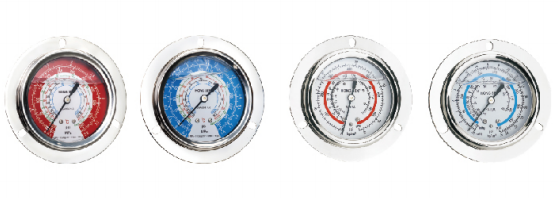
On a pump skid or a hammer mill, the needle on a standard pressure gauge rarely sits still. It twitches in rhythm with the equipment, swings wide during startup surges, and eventually wears the pinion and hairspring into a sloppy, unreliable readout. The problem is not just cosmetic. A gauge that bounces around hides real pressure spikes and can make an operator ignore a dangerous trend because the numbers never settle long enough to read. Understanding how vibration enters the movement—through the socket, the case, and even the pointer’s own inertia—is the first step toward keeping that needle readable.
The quickest fix is to switch to a liquid-filled gauge. The glycerin or silicone oil inside the case does more than damp the pointer; it coats the internal movement, reduces wear from constant micro-motion, and adds mass that lowers the natural frequency of the needle assembly. For more aggressive vibration, a restrictor orifice or a snubber installed at the inlet can slow pressure transients without affecting steady-state readings. Remote mounting the gauge on a bracket with a flexible capillary line also breaks the direct mechanical path from the vibration source, and in some cases, changing the gauge’s orientation so the pointer’s plane is perpendicular to the dominant vibration axis helps reduce sympathetic oscillation.
But damping has a trade-off. Too much damping hides rapid pressure changes and makes the gauge sluggish to respond during shutdown or relief events. That is why selecting the right fill fluid matters: glycerin works well in moderate temperatures and vibration, while silicone holds up better in cold or hot environments and resists thickening. Field checks should include looking for fluid leakage around the fill plug, checking that the case is still full enough to cover the movement, and replacing gauges that have gone cloudy or developed bubbles from cavitation. A steady needle is not about eliminating all movement—it is about making the movement small enough and slow enough that an operator can trust what the gauge is telling them.
Glycerin vs. Silicone: Matching Fill Fluid to Your Process
Choosing between glycerin and silicone fill fluid often comes down to how your process behaves under real conditions. Glycerin is the workhorse for general-purpose gauges, offering reliable damping in mild temperatures and pressures without breaking the budget. But push it near freezing or expose it to aggressive chemicals, and it starts to lose its composure. Silicone, by contrast, steps in when the environment turns hostile—wide temperature swings, pulsating lines, or contact with corrosive media are where it earns its keep. The trick is knowing which failure mode costs you more: a gauge that freezes solid in winter, or one that slowly degrades from a fluid that wasn’t meant for the job.
Temperature is the first fork in the road. Glycerin thickens noticeably below 0°C, turning your pressure readings sluggish and eventually immobilizing the pointer. If your process lives outdoors or in cold storage, silicone’s low-temperature stability—often down to -40°C or lower—keeps the needle responsive without the syrup effect. On the flip side, glycerin handles high heat better than some low-viscosity silicones, so a steam line at 150°C might be fine with glycerin while a lightweight silicone thins out and loses damping. It’s not about which fluid is universally better; it’s about the actual temperature envelope your gauge will sit in day after day.
Chemical compatibility and maintenance habits also tip the scales. Glycerin is water-soluble and generally safe around food-grade or mild aqueous processes, but it will pull moisture from humid air and can promote corrosion in brass internals over time. Silicone resists oxidation and won’t absorb water, making it the quieter choice for sealed systems or long service intervals. However, silicone’s higher cost and occasional incompatibility with certain elastomers mean you shouldn’t default to it without checking the wetted parts. Ultimately, the right fill fluid is the one that disappears into the background—no freeze-ups, no swelling seals, no surprise downtime. Match it to your process, not to the spec sheet alone.
Brass, Stainless, or Plastic? Case Choices That Matter
Brass has a warm, lived-in appeal that starts showing up after only a few weeks of handling. It doesn't try to stay shiny; instead, it picks up a mix of darker smudges and faint green traces around the edges, almost like an old tool that remembers every job. Some people love that slow change, while others get annoyed by the metallic smell it leaves on skin during hot afternoons.
Stainless steel is the easy choice if you'd rather not think about upkeep. It shrugs off scratches from daily use, holds a brushed or polished finish without much fuss, and rinses clean under a tap. There's no need to wipe it down with special cloths or worry about discoloration, though the first touch on a cold morning can feel sharper than expected.
Plastic often gets dismissed, but it handles hard knocks better than the other two. Its real strength is weight: you can wear it all day during a run or at a workbench and barely notice it's there. Scratches show up more easily on high-gloss surfaces, and extended sun exposure can shift the color, yet for something you don't mind dropping, plastic makes a lot of sense.
Mounting and Venting Steps Most Installers Overlook
Many installers torque every bolt to spec but never check whether the mounting surface is truly flat. A slight bow or uneven weld can twist the equipment frame once it's pulled down tight, leading to micro-deformations that throw off fan balance months later. Just as common is skipping the isolation pads between the unit and its stand — without them, vibration travels straight into the building structure, producing a low hum that only becomes noticeable during quiet nighttime operation.
Ductwork connections hide their own blind spots. The focus is usually on flange alignment and gasket compression, yet the inside of the duct often carries construction debris like drywall dust or sheet metal screws. Once the blower spins up, those fragments get sucked into the impeller, chipping blades and wrecking the dynamic balance. Exhaust termination gets little thought too: a vent pointed straight at a nearby intake creates a hot-air short circuit, quietly raising operating temperatures even when the calculated airflow looks fine on paper.
Condensate routing is another step that gets rushed. For units with dehumidification or cooling coils, a drain line without a consistent downward slope — or missing a proper trap — will hold water in low spots. That stagnant moisture becomes a breeding ground for biofilm and slowly corrodes the pan. Some crews hide the drain inside a wall chase for a cleaner look but forget to leave an access panel, so the first clog turns into a drywall-cutting job rather than a quick cleanout.
How to Compare Chinese Suppliers on More Than Price
Price is the easiest thing to compare, but it rarely tells you how a supplier will behave when something goes wrong. A low quote might reflect thinner materials, slower lead times, or a team that cuts corners on quality control. Instead of asking only “how much per unit,” dig into how they handle revisions, what tolerances they actually hold, and whether they proactively flag design issues before production starts.
Look at the communication rhythm. Do they reply in hours or days? Do they ask clarifying questions or just say “yes” to everything? A supplier that understands your use case will often suggest cheaper or more reliable alternatives—that signals real engineering input, not just sales talk. Check their sample policy too: will they send a pre-production sample for approval, or do they expect you to commit first?
Finally, verify their consistency beyond a single order. Ask for references from clients with similar volumes, not just a generic certificate list. Visit the factory if possible, or request a live video walkthrough of the production line and QC area. A trustworthy partner will welcome scrutiny, while one hiding behind price alone will dodge the hard questions.
FAQ
Oil-filled gauges have a liquid-filled case, usually glycerin or silicone, that dampens pointer vibration, lubricates moving parts, and blocks moisture and corrosive atmospheres from reaching the internals. Dry gauges are fine in stable conditions, but under pulsating pressure from pumps, compressors, or hydraulic systems the needle can flutter, making readings hard to take and wearing out the movement faster.
Chinese manufacturers have improved precision machining, quality control, and material sourcing significantly. Many factories now use automated calibration equipment and follow international standards such as EN 837-1 or ASME B40.100. Because the supplier base for brass fittings, Bourdon tubes, and cases is concentrated, key components are produced with consistent quality and at lower cost, which does not automatically mean lower reliability.
Pick a range so your normal working pressure sits between 25% and 75% of the full scale. For fluctuating pressure, keep the maximum working pressure below 50% of the full scale to reduce Bourdon tube fatigue. If the system has pressure spikes, consider a snubber or a higher range so the gauge is not constantly pegged near its limit.
Glycerin works for most general-purpose applications with temperatures roughly from -20°C to 65°C, and it costs less while providing good damping. Silicone oil handles a wider temperature range, often -40°C to 80°C or higher, and offers better compatibility with certain chemicals, but it is more expensive. If you have strong oxidizers or sanitary requirements, choose silicone or consult the manufacturer.
Yes, but the fill fluid's viscosity changes with temperature. Glycerin thickens in freezing conditions and can make the pointer sluggish or the dial appear cloudy. Silicone performs better at low temperatures. For outdoor installations, look for silicone-filled models with stainless steel cases and a vented or freeze-resistant design so the case does not crack from internal expansion.
Common sizes are 1/4" NPT, 1/2" NPT, G1/4, or G1/2. Chinese manufacturers typically offer NPT, BSP (G), and metric threads. Always match the thread to your system: North America often uses NPT, while Europe and Asia lean toward G threads. Mixing NPT and BSP can cause leaks or thread damage.
Annual calibration is a sensible baseline, though critical process or safety-related applications may need checks every six months. If the gauge sees heavy vibration, overpressure, or frequent temperature cycles, shorten the interval. Calibration catches zero drift, sticky pointers, or Bourdon tube fatigue before they lead to bad readings.
A small air bubble is usually harmless and comes from oil volume changes with temperature. Widespread cloudiness, however, often means aged fluid, water ingress, or internal corrosion. If the dial is still readable and accuracy is within tolerance, you can keep using it; otherwise, replace the gauge or have it refilled. Make sure the case vent is not blocked to avoid pressure buildup inside.
Conclusion
The oil inside these gauges does more than damp movement; it changes how pressure reaches the bourdon tube. When the system spikes, the fluid slows the tube's uncoiling just enough to let the needle settle instead of slamming against the stop. That same viscosity also keeps the pointer readable on pumps or compressors where solid-front gauges would blur. But fill fluid is not a one-size-fits-all choice. Glycerin handles most ambient conditions and resists freezing down to about -20°C, while silicone suits wider temperature swings and stays thinner in cold process lines. Matching that fluid to the actual operating range prevents sluggish readings or leaks at the case seal.
Housing material often determines whether the gauge survives a washdown or corrodes quietly behind the panel. Brass cases are cheap but vulnerable to ammonia and salt spray; stainless holds up in food plants and offshore skids where rust is non-negotiable. Plastic can work for low-pressure utilities but warps near steam tracing. Just as important are the steps installers skip: cutting the fill plug only after mounting, venting air trapped under the diaphragm, and checking that the case is not used as a wrenching point. When comparing Chinese suppliers, ask for burst-pressure test videos, finish thickness on stainless cases, and the actual silicone grade used—not just the export price. Those details tell you more than a polished catalog page.
Contact Us
Contact Person: KOPASS HO
Email: [email protected]
Tel/WhatsApp: 8613606566112
Website: https://www.hongsenref.com/