China Grating Clip Types, Materials, and Installation Methods Explained
2026-11-02
Most grating failures don’t start with the grating itself—they start with the clip. Get the type, material, or torque wrong, and even premium panels work loose. From saddle clips and G-clips to stainless steel and galvanized options, understanding what’s coming out of China’s factories changes how you specify and install. Sino Grating brings field-level detail to clip selection, so your next platform stays put long after the handover.
Which Grating Clip Type Fits Your Project?
Choosing the right grating clip usually comes down to how the panel gets loaded and whether you ever need to lift it. Saddle clips are the workhorse for heavy, permanent installations—they wrap over two bearing bars and bolt through from above, holding everything tight even under vehicle traffic. If your project involves frequent removal for cleaning or inspection, a G-clip or U-clip might be a better friend: they fasten from below in many cases, leaving the top surface clear while still allowing a faster unfasten when you know how to reach them.
Material compatibility matters more than it first appears. Aluminum grating paired with steel clips invites galvanic corrosion, especially outdoors or in washdown areas. Coated or stainless clips close that gap cheaply compared to repairing the grating later. Also check the bearing bar profile—flat bars, serrated surfaces, and swaged grating each interact differently with clip teeth. A clip that slips under load becomes a trip hazard, so match the clip profile to the bar instead of forcing a universal fit.
Finally, count your attachment points and think about actual working conditions. Edge clips alone often fail in high-vibration or heavy lateral load areas; adding center clips or saddle assemblies spreads the stress. For grating near drainage channels or chemical exposure, look for a clip with a lower profile and a corrosion-resistant finish—not just a shiny bolt. The right choice is rarely the cheapest per piece, but the one that keeps the panel from rattling, shifting, or becoming a maintenance nuisance.
Galvanized or Stainless? A Field-Tested Material Comparison
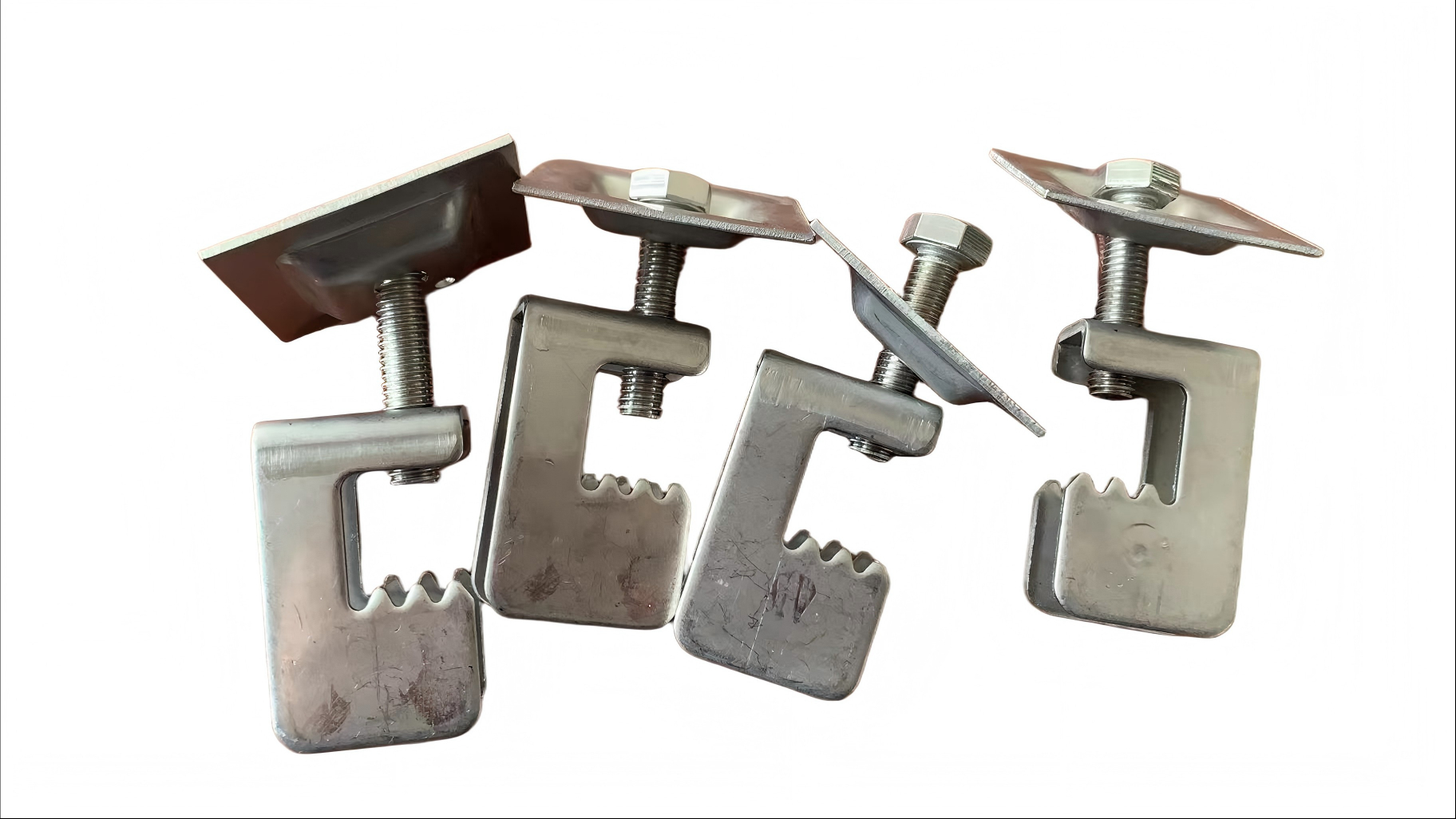
After three winters of road salt, beach air, and forgotten wet gear in truck beds, the differences between galvanized steel and stainless steel stop being theoretical. Galvanized holds up fine until the zinc coating gets scratched, then rust creeps under the edges and spreads quietly. Stainless laughs off the same abuse, but you pay for that resilience up front and again when you need specialty bits or a steady hand to avoid galling threads.
For most outdoor brackets, trailer hardware, or fence fittings, hot-dip galvanized is still the workhorse. It is cheap, widely available, and the coating is thick enough to survive years of weather if you do not grind or drill through it after installation. Once you modify a galvanized part in the field, though, you have exposed raw steel and the clock starts ticking. A cold-galv spray can slow the damage, but it's a patch, not a repair.
Stainless earns its keep in marine environments, food processing, or anywhere appearance matters long term. We have pulled 304 stainless bolts out of dock plates after five years that looked new except for minor tea staining. The trade-off is mechanical: stainless is softer and more prone to seizing under load, so anti-seize and correct torque become non-negotiable. Choose galvanized when budget and bulk matter; choose stainless when the part has to outlive everything around it.
Can You Install Grating Clips Without Welding?
Absolutely. Welding used to be the default for securing grating panels, but it brings a host of headaches—warping, burn-through on thinner stock, and a real pain when you need to swap out a damaged section. Today, plenty of installers skip the torch entirely. Mechanical fasteners like saddle clips, G-clips, and bolt-down brackets grip the support steel firmly without melting a single bead. For most industrial walkways and mezzanines, these non-welded solutions hold up just as well under foot traffic and light vehicle loads.
The real advantage of going weld-free shows up on galvanized or stainless grating. Welding destroys the protective zinc layer at every joint, inviting rust within months. Mechanical clips leave the coating intact and let you remove a panel in minutes with a standard wrench. You also avoid the expense of a certified welder and the downtime of fire watch on site. That said, not every no-weld clip suits every job—check the manufacturer's load ratings and pair the right clip style with your support bar spacing. Done correctly, the only sparks you'll see are from the grinder when you're trimming the last panel to fit.
Matching Clip Strength to Real-World Load Conditions
A clip rated for 25 kN might seem like overkill until you look at what actually happens during a fall or a sudden stop. Most failures don't occur because the clip was too weak on paper—they happen because the load arrived at an angle, with a jerk, or after thousands of small stress cycles. Gate-open strength, cross-loading, and wear near the hinge all cut into the real margin far more than the number stamped on the spine suggests.
To match clip strength to real-world conditions, start by measuring the peak force you expect, not just the static weight. Add the effect of any drop, swing, or wave motion if the clip is on a boat or rigging line. Then choose a clip whose working load limit sits well below its minimum breaking strength, and verify that the gate mechanism can handle a snatch load without deforming. If the clip sees salt, grit, or repeated opening, factor that into replacement intervals instead of assuming the original rating still holds.
What China's GB Codes Require for Grating Fixings
The GB framework treats grating fixings as load-path components, not afterthoughts. For welded installations, the codes demand a minimum of three bearing bars per anchor point, with fillet welds no shorter than 20 mm on each side of the bar. Any skip welding is limited to non-load-bearing edges, and you cannot simply tack corners—the weld must carry through the full contact face. If the grating sits in a constantly wet or chemically aggressive zone, the weld zone itself needs an additional protective coat after grinding, typically a zinc-rich touch-up unless the spec calls for stainless filler.
Mechanical fixings get tighter scrutiny under GB codes. Saddle clips, M-bolts, and J-bolts must match the grating's bearing bar pitch exactly; using a clip designed for a 30 mm pitch on a 40 mm bar voids compliance. Torque values are not left to installer discretion—typical M8 fasteners require 18–22 N·m, and over-torquing beyond 25 N·m is flagged because it deforms the clip and reduces pull-out resistance. For pedestrian platforms, the code requires fixing points at every second bearing bar along the perimeter, but for vehicular grating or trenches crossing traffic lanes, spacing drops to every bearing bar, and you must add a lock washer plus a secondary nut or a self-locking insert.
Edge distances and end conditions also matter. A fixing hole drilled closer than 25 mm from the bearing bar's free end is non-compliant; the load path relies on at least that much surrounding metal to prevent tear-out. When grating panels butt against a curb or channel, the GB code insists on an edge trim or nosing bar that is itself anchored—not just resting—so that the fixing load transfers into the supporting steel. Missing that small detail is one of the most common reasons a site inspection returns a failure even when the visible clips look correct.
The Most Common Installation Errors That Loosen Gratings
Many installers underestimate the importance of proper torque on grating clips. Overtightening can shear the clip or distort the bearing bar, while undertightening leaves enough play for vibration to work the fastener loose over time. A torque wrench should be used, and the manufacturer’s recommended values followed—not just “felt tight.”
Another frequent culprit is using the wrong type of saddle clip for the bar spacing. If the clip doesn’t match the pitch of the bearing bars, it may sit on top of the bar instead of gripping the cross rod, creating a hinge point that allows lateral movement. This is especially common in renovations where old grating is replaced with a different spacing, but the existing clips are reused.
Finally, ignoring thermal expansion can cause seemingly tight gratings to loosen as temperatures fluctuate. Metal expands and contracts, so a grating that’s firmly anchored on a hot day may have visible gaps and rattling in winter. Installing slotted holes or using expansion joints at designated intervals prevents the fasteners from being pulled out as the panels shift.
FAQ
You'll typically run into four kinds: saddle clips, G-clips, M-clips, and flat bar clips. Saddle clips wrap over the bearing bar and bolt down, making them a solid all-around choice. G-clips hook underneath the bar, so they're handy when you don't want anything protruding above the grating surface. M-clips are basically a lower-profile version of saddles, and flat bar clips work well when clearance is tight.
Most clips in China are made from galvanized steel, stainless steel (304 or 316), or sometimes aluminum. Galvanized steel is the budget-friendly option for most indoor or mild outdoor jobs. Stainless steel 304 handles general corrosive environments, while 316 is needed for coastal or chemical-heavy areas. Aluminum clips show up where weight matters or where galvanic corrosion with aluminum grating is a concern.
Place the clip so its saddle straddles the bearing bar, then insert the bolt through the hole in the top plate or support member. Tighten the nut from below until the clip holds the grating firmly without distorting the bar. For most bar thicknesses you'll want at least two clips per panel, but high-traffic areas may require four or more. Always check that the clip doesn't lift the panel at the edges.
G-clips have a distinctive notched shape that grips the underside of the bearing bar, so no top plate is needed and the surface stays smooth. M-clips look more like a saddle clip but with a lower rise, making them ideal when you need a secure hold yet have limited vertical space above the grating. Both are reusable, but G-clips can be trickier to align if the bars are uneven.
It depends on the environment. If you're installing grating near the coast, in a chemical plant, or anywhere with high humidity and salt exposure, stainless steel 316 clips are the safe bet. For general outdoor use away from harsh pollutants, hot-dipped galvanized steel clips usually last for years. Just keep in mind that using stainless clips with plain steel grating can sometimes create a galvanic reaction, so match materials where possible.
You can reuse them if the clips are still straight and the bolt threads aren't stripped. Saddle and M-clips often survive multiple removals, but G-clips can get deformed if pried off carelessly. Before reusing, check for cracks, rust pitting, or bent legs that would reduce clamping force. When in doubt, replace them—clips are cheap compared to a loose grating panel.
At minimum you'll need a socket wrench or spanner that matches the clip bolt size, plus a torque wrench if the job specifies a tightness value. A pry bar or flathead screwdriver helps align the grating beforehand. For overhead or awkward positions, a magnetic bolt holder and locking pliers can save a lot of frustration. Always wear gloves because galvanized edges can be sharp.
Conclusion
Choosing the right grating clip in China often starts with three practical options: saddle clips for standard steel grating, G-clips for tight seams, and flat bar or L-type hold-downs where access is limited. Saddle clips remain the workhorse in Chinese industrial flooring because they distribute clamping force across two bearing bars. Galvanized versions using Q235 steel are widely specified for indoor plants and general platforms, while 304 or 316 stainless clips outperform them near coastlines or in chemical washdown areas. Field experience shows hot-dip galvanizing can last 15 to 20 years in mild environments, but the extra cost of stainless often pays off where chloride exposure or acid fumes shorten coating life.
No-weld installation is entirely feasible—most Chinese suppliers now offer bolt-to-steel, anchor-to-concrete, and pour-in insert methods that avoid on-site hot work. For concrete, cast-in channel or embed plates allow fastening after grating placement, and for existing slabs, expansion or chemical anchors give reliable pull-out values when edge distance is respected. Matching clip strength to real load conditions matters: static walkways can use standard M8 or M10 bolts, but loading docks, trench covers, or areas with forklift traffic need reinforced saddle clips and closer spacing to resist fatigue. China's relevant GB codes—covering hot-dip coatings, fastener materials, and structural welding—set minimum requirements that many projects unknowingly exceed. The most common installation errors include under-tightening, omitting flat washers, mixing stainless and galvanized parts without isolation, and failing to allow for thermal movement, all of which lead to loose gratings and premature replacement.
Contact Us
Contact Person: Nicholas Zhu
Email: [email protected]
Tel/WhatsApp: 18921275456
Website: https://www.sino-grate.com